Blog·
Woody regrowth vs ballast vegetation: telling them apart in corridor imagery
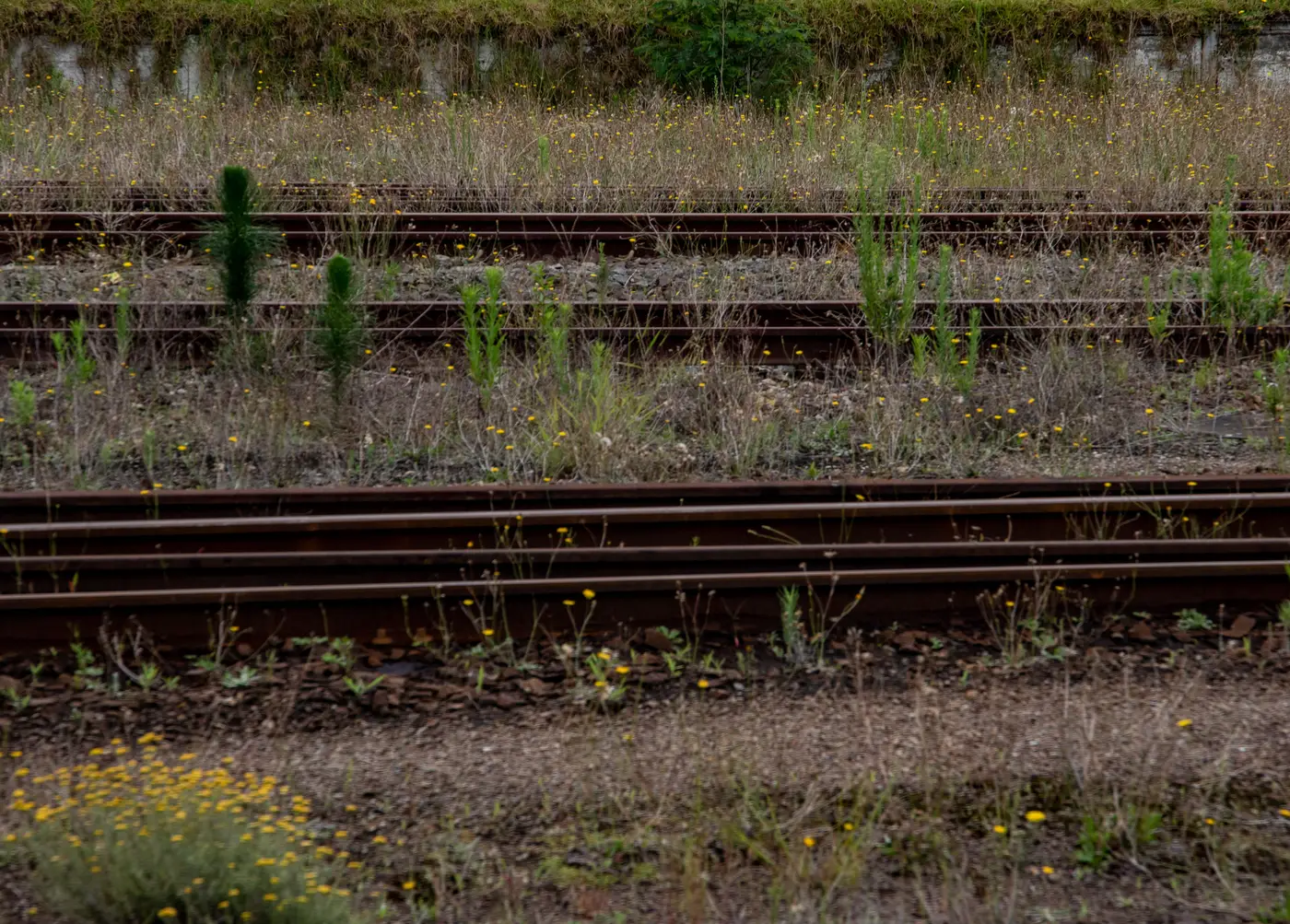
If you've sat through a vegetation-management scoping meeting, you've heard the two terms get used almost interchangeably. They shouldn't be. Ballast vegetation and woody regrowth are different problems, they grow in different places, and a contractor pricing a flail mow is not the same contractor you need for stump treatment and selective felling near a signal.
Getting the two mixed up in a work order wastes a mobilisation. Getting them mixed up in a sighting-distance assessment is worse.
What ballast vegetation actually is
Ballast vegetation is low growth rooted in the ballast shoulder, the cess, or between sleepers: grasses, weeds, occasional self-seeded buddleia. It spreads fast because ballast holds moisture and catches windblown seed off adjacent land. Left alone it chokes drainage, traps fines, and eventually you're dealing with wet beds rather than a mowing job.
In corridor imagery this stuff has a flat, even canopy that hugs the track geometry rather than standing proud of it. At 0.5 m GSD you won't resolve individual grass blades, but you don't need to: the signature is a continuous low-reflectance band running parallel to the rails, brightest in the near-infrared because healthy grass and weed cover reflects NIR hard. It registers as a continuous texture shift across the ballast shoulder, identified by its color and continuity rather than by any distinct outline.
What woody regrowth looks like instead
Woody regrowth is a different animal: saplings, scrub, coppice shoots coming back from cut stumps, bramble thickening into scrub. It comes in from the boundary fence and the cess edge, and it grows vertically, which is the whole problem for signal sighting. A stand of self-seeded ash or sycamore that was a knee-high nuisance two growing seasons ago can be head-height and blocking a driver's view of a distant signal by year three.
In the imagery, woody regrowth shows up as discrete, often irregularly shaped canopy clumps rather than a continuous band. Individual crowns start to resolve as separate blobs once they're past sapling stage, and they cast a shadow onto the ballast or cess in morning or evening passes that ballast vegetation simply doesn't produce, because ballast vegetation has no height to cast one. The NIR response is similarly strong (live woody foliage reflects NIR too), but the shape and the shadow are what separate it from a grass mat. Height is really the tell: anything standing proud enough to throw a shadow or break the skyline in a signal's sightline is regrowth, not ballast cover.
Why the distinction changes the work order
This matters because the two call for different crews and different timing. Ballast vegetation is a mowing or spraying job, usually scheduled on a cycle tied to the growing season. Woody regrowth is a felling, coppicing, or stump-treatment job, and if it's sitting in a signal's line of sight it's not discretionary, it's a compliance item with a clock on it.
A table that just says "vegetation present at chainage X" doesn't tell a contractor which crew to send or whether it's urgent. A table that separates encroachment type (ballast vegetation vs woody regrowth), gives a distance to track, and flags which woody regrowth entries sit against a signal's sighting line gives them something they can act on without a site visit to figure out what they're actually looking at.
That's the kind of output you get from an annual pass over the corridor with RGB and near-infrared imagery at a resolution fine enough to separate a grass mat from a scrub clump, rather than a windscreen survey that catches whatever the walker happened to notice that day.
If you'd rather hand a contractor a location-by-location table than argue over what counts as regrowth, take a look at how Rail Vegetation Monitoring builds that table from a single annual imagery pass across the corridor.