Blog·
Leaf fall risk trees vs trackside encroachment: reading the difference in corridor imagery
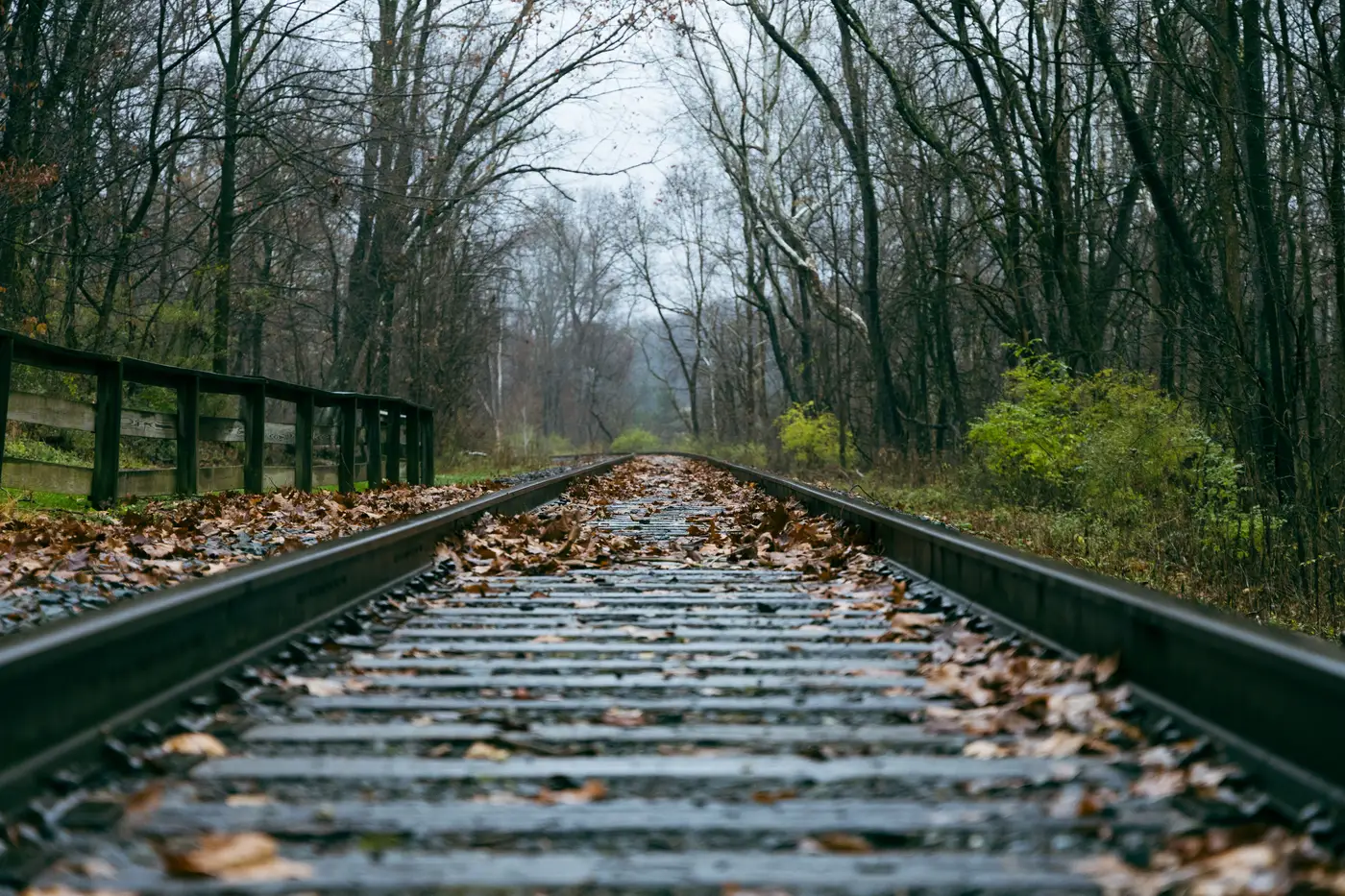
Two trees can sit thirty metres apart on the same embankment and belong to entirely different work orders. One is a leaf fall risk, flagged for the autumn adhesion programme. The other is encroachment, flagged because it's growing into the clearance envelope or blocking a driver's view of a signal. Both get called "a tree problem" by whoever walks the line, but they're not managed the same way, funded from the same budget, or cleared on the same timetable. If your imagery review lumps them together, you end up sending a vegetation contractor to the wrong job.
What makes a tree a leaf fall risk
Leaf fall risk comes down to what happens to the rail head in October and November, when a deciduous broadleaf canopy sheds onto the running line and gets compressed into a slippery film by passing wheels. The trees that matter here are specific: ash, sycamore, oak, and similar broadleaf species with canopy that overhangs or sits close enough to the track to drop leaf litter directly onto the rail, particularly on approaches to stations, curves, and gradients where low adhesion has the biggest operational consequence.
Distance to track matters less here than canopy position and species. A broadleaf tree set back from the formation but leaning over it is a leaf fall candidate even if its trunk is well outside any clearance boundary. A conifer at the same distance usually isn't, because it doesn't shed the same way.
What makes a tree an encroachment problem
Encroachment review asks the same three things regardless of species: is the canopy or stem inside the structure gauge, is it closing in on the running line faster than the clearance cycle accounts for, and does it sit between a signal and the point on the approach where a driver needs to see it. A fast-growing willow scrub regrowth on a cutting slope can become a sighting distance problem in two or three growing seasons even if it never drops a leaf near the rail head. That's a different clock running on a different reason.
Encroachment review has to be checked against every signal location on the corridor as well as the track edge. A tree can sit comfortably outside the clearance envelope and still cut the sighting distance to a signal around a curve.
Telling them apart in imagery
In RGB+NIR corridor imagery, the two signals you're reading are different. Near-infrared reflectance picks up canopy health and gives a reasonable species-level signature for broadleaf versus conifer, which is the first sort for leaf fall risk. Encroachment, on the other hand, comes down to plain measurement: distance from the canopy edge or stem to track centreline, and distance from any vegetation to the sighting line of each signal along the approach. One is a classification question, the other is a geometry question, and trying to answer both with the same pass over the imagery is how trees end up on the wrong list.
A corridor walk-through or an imagery review ends up asking two separate questions on two separate timelines. The adhesion programme needs species and canopy position relative to the rail, assessed before autumn. The clearance and sighting review needs distance measurements against track centreline and signal sighting lines, assessed as part of the annual encroachment survey. Most corridors run both, on different schedules, going to different people.
Rail Vegetation Monitoring is built around the second question. It covers the corridor once a year from VHR imagery and hands back a table with location, encroachment type, distance to track, and any signal sighting distance that's come in short, ready to pass straight to a vegetation-management contractor.
If sighting distance compliance and encroachment tracking are what's eating your time each clearance cycle, see how the annual table works for your corridor.